
· by Sonny Miller
What Old Coins Are Actually Worth in 2026
Wondering what your old coins are worth? A plain-English breakdown of silver value, key dates, errors, and condition — from a Southern California coin buyer.
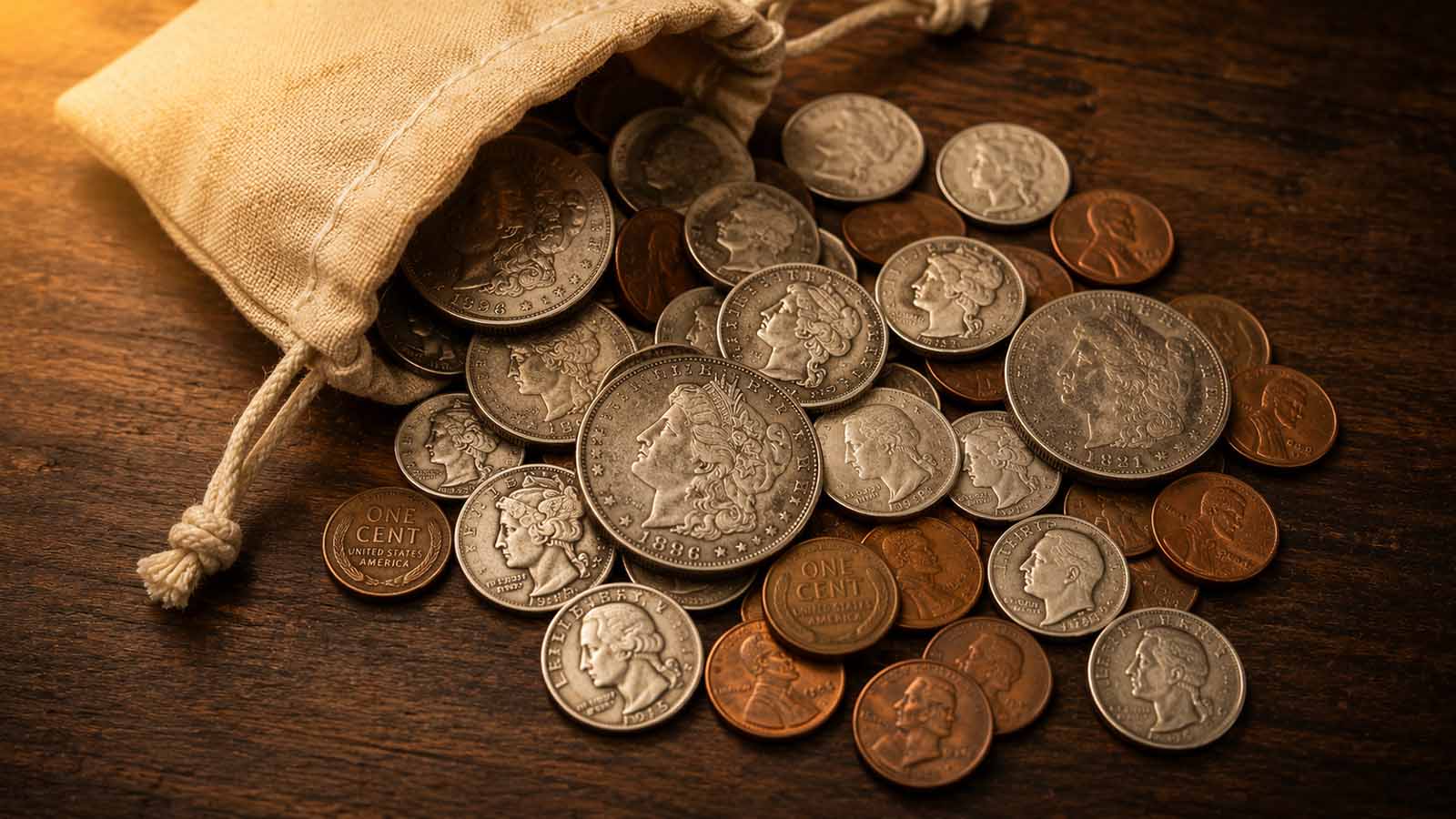
Hey, Sonny here. One of the questions I get more than any other — usually from someone who just opened a jar their dad left in a drawer — is “are these worth anything?” The honest answer is sometimes a lot, sometimes not much, and you really can’t tell by looking at them. But there’s a framework for thinking about it, and once you understand the four things that drive coin values, you stop guessing.
Here it is.
1. Silver content (the floor under most old coins)
Any US dime, quarter, half dollar, or dollar made in 1964 or earlier is 90% silver. That alone gives them a baseline value tied to the silver spot price — completely separate from whether they’re collectible.
As of 2026, silver has been trading in a range that makes those coins worth several times their face value just for the metal. A roll of 1964 quarters that someone got at the bank for $10 might melt for $80 to $100 depending on the day. Half dollars from 1965-1970 are 40% silver — still worth a premium, just less.
This is why “junk silver” isn’t really junk. It’s the most predictable category of value in the whole coin world. If you’ve got pre-1965 silver coins, you have money — the only question is how much.
2. Key dates and mint marks (where the real money hides)
This is where collections get interesting. A coin’s date and mint mark — the little letter under the date that tells you which mint struck it (P, D, S, CC, O) — can turn an otherwise common coin into something genuinely valuable.
A few examples that show up in regular collections:
- 1909-S VDB Lincoln cent — looks like a normal wheat penny, can be worth $1,000+ in good condition
- 1916-D Mercury dime — same coin as the others in the roll, except this one is worth thousands
- 1932-D and 1932-S Washington quarters — first year of the series, low mintage, serious money
- 1893-S Morgan dollar — one of the most famous key dates in US coinage
Here’s the catch: you can have a hundred Morgan dollars and ninety-nine of them are common dates worth $30-40 each, and one is the 1893-S worth $3,000+. Without checking each one, you’d never know.
That’s the whole reason valuation isn’t a quick eyeball job.
3. Condition (the multiplier on everything else)
Two identical coins from the same year and mint can have a 10x or 100x price difference based on condition. Grading is a real skill — professional graders at PCGS and NGC use a 70-point scale, and a single grade jump (say, from MS-64 to MS-65) can double a coin’s value.
You don’t need to know the grading system. What you do need to know is:
- Don’t clean coins. Ever. Cleaning destroys the surface, kills the grade, and can wipe out 80-90% of the value. I’m going to write a whole separate post about this because people are still doing it.
- Don’t store them loose in a jar where they bang against each other.
- Don’t separate them from the album or holder they came in unless a pro tells you to.
If you’ve inherited a collection, the worst thing you can do is “tidy it up” before someone looks at it.
4. Errors and varieties (the wildcard)
Mint errors — double dies, off-center strikes, wrong planchets, missing letters — can turn a 25-cent coin into a four-figure coin. The famous 1955 Doubled Die Lincoln cent is the poster child: a regular wheat penny that’s worth $1,500+ in average condition because of a striking error.
These are rare, but they do show up. I’ve found error coins in collections people thought were worthless. It’s one of the reasons we look through everything, even the rolls of “common” pennies.
So what’s your collection actually worth?
Here’s the unsatisfying but honest answer: you can’t tell without someone looking at it. Online value guides give you ranges, but they assume a specific grade and a specific market — and they don’t account for the half-dozen sleeper coins hiding in a typical drawer-clean-out collection.
What I can tell you is what to do next:
- Don’t clean anything. Worth saying twice.
- Don’t sort by “looks valuable” vs “looks plain” — the valuable ones often look plain.
- Get it valued by someone who actually buys coins, not just an appraiser. Appraisers tell you what something might sell for. Buyers tell you what they’ll actually pay.
That’s what we do. We’ll come to you, look through everything carefully, walk you through what you have, and make you a real offer on the spot. Free valuation, no obligation, no pressure to sell.
📞 (714) 987-1931 — call or text. We cover all of Orange County, LA, Riverside, San Bernardino, and San Diego counties.
Your coins. Our expertise. Your cash.
— Sonny